
Quick Summary
Overhead leaks across Astoria's pre-war and multi-family properties create severe structural collapse and mold hazards when trapped moisture weakens plaster-and-lath keys or drywall framing. For effective ceiling water damage repair in Astoria, Floodline Restoration Co. delivers rapid containment, thermal moisture mapping, and structural drying designed specifically for historic plaster and complex building assemblies. Readers will learn essential emergency containment steps and can contact Floodline Restoration Co.'s 24/7 dispatch line for an immediate 45-minute on-site response and a free visual ceiling inspection.
Ceiling Water Damage Repair in Astoria – Fast Recovery Guide
A leaking or sagging ceiling is an immediate emergency. Whether dealing with a multi-family building, a rowhouse, or a mixed-use space, ceiling water damage requires fast containment and specialized drying. Water traveling across overhead framing quickly saturates building materials, creates electrical hazards, and threatens structural stability.
Older properties present unique challenges during a water loss. Plaster-and-lath assemblies, shared party walls, and continuous wood joists allow water from an upstairs radiator leak or burst supply line to migrate far from the original source. Professional water mitigation from teams like Floodline Restoration Co. stops active water migration, pinpoints moisture hidden behind structural assemblies, and prevents permanent structural loss. See also Water Damage Restoration in Astoria | Call Now-10% Off | Same-Day Service | Free Estimate.
Quick Action Guide for Overhead Water Leaks
If water is coming through your ceiling right now, take these immediate steps before technicians arrive:
- Cut power safely: Switch off the circuit breakers controlling fixtures, ceiling fans, or outlets in the affected room.
- Relieve water weight: If you see a sagging bubble in drywall or paint, place a bucket beneath the lowest point and make a small puncture with a screwdriver to release pooled water and prevent an uncontrolled collapse.
- Trace and isolate the source: If the leak stems from an upstairs plumbing line or radiator valve, turn off the fixture shut-off valve or main water line immediately.
- Document everything: Take clear, timestamped photos and video of the ceiling, water entry points, and any damaged personal property for insurance purposes.
According to the U.S. Environmental Protection Agency (EPA) WaterSense program, household leaks can waste substantial amounts of water annually, with severe supply line or fixture leaks quickly saturating subflooring and ceiling cavities below. Immediate structural extraction and controlled drying are necessary to protect the property framing and prevent microbial growth.[1]
What Does Ceiling Water Damage Repair Cost?
Need ceiling water damage repair in Astoria?
We’re available now - call for a fast, free estimate.
Ceiling repair and water extraction costs vary based on the volume of water, the height of the ceilings, and the materials involved. Repairing modern drywall is generally straightforward, whereas restoring saturated plaster-and-lath requires specialized stabilization and containment.
While Astoria-specific statistics are not available, typical ceiling repairs generally range from $150 to $4,400 across the industry, with planning estimates commonly falling between $45 and $55 per square foot depending on the extent of damage and materials required.
Key Factors That Drive Repair Expenses
As specialists at Floodline Restoration Co. note, several real-world building variables affect the final price of overhead water restoration:
- Material type: Plaster and wood lath take substantially more labor to stabilize or safely remove than modern drywall panels.
- Water contamination level: Clean supply line leaks (Category 1) cost less to clean than radiator water, storm run-off, or multi-family drain line backups (Category 2 and Category 3).
- Hidden framing cavities: Multi-layer subflooring and joist bays in older buildings trap moisture, requiring specialized positive or negative air injection systems to dry the cavity without tearing down sound framing.
- Lead and asbestos testing: Older buildings often require environmental testing before extensive demolition can begin.
Navigating New York Homeowners Insurance
According to the Insurance Information Institute, water damage and freezing accounted for 27.6 percent of homeowners insurance losses in 2022. Most standard New York homeowners insurance policies cover sudden and accidental water damage, such as a frozen pipe burst or sudden appliance failure. Gradual leaks caused by deferred maintenance are typically excluded. Providing your carrier with detailed moisture logs, thermal images, and itemized contractor scopes ensures your claim is properly evaluated.[2]
The Hidden Danger: Plaster-and-Lath Ceilings vs. Modern Drywall
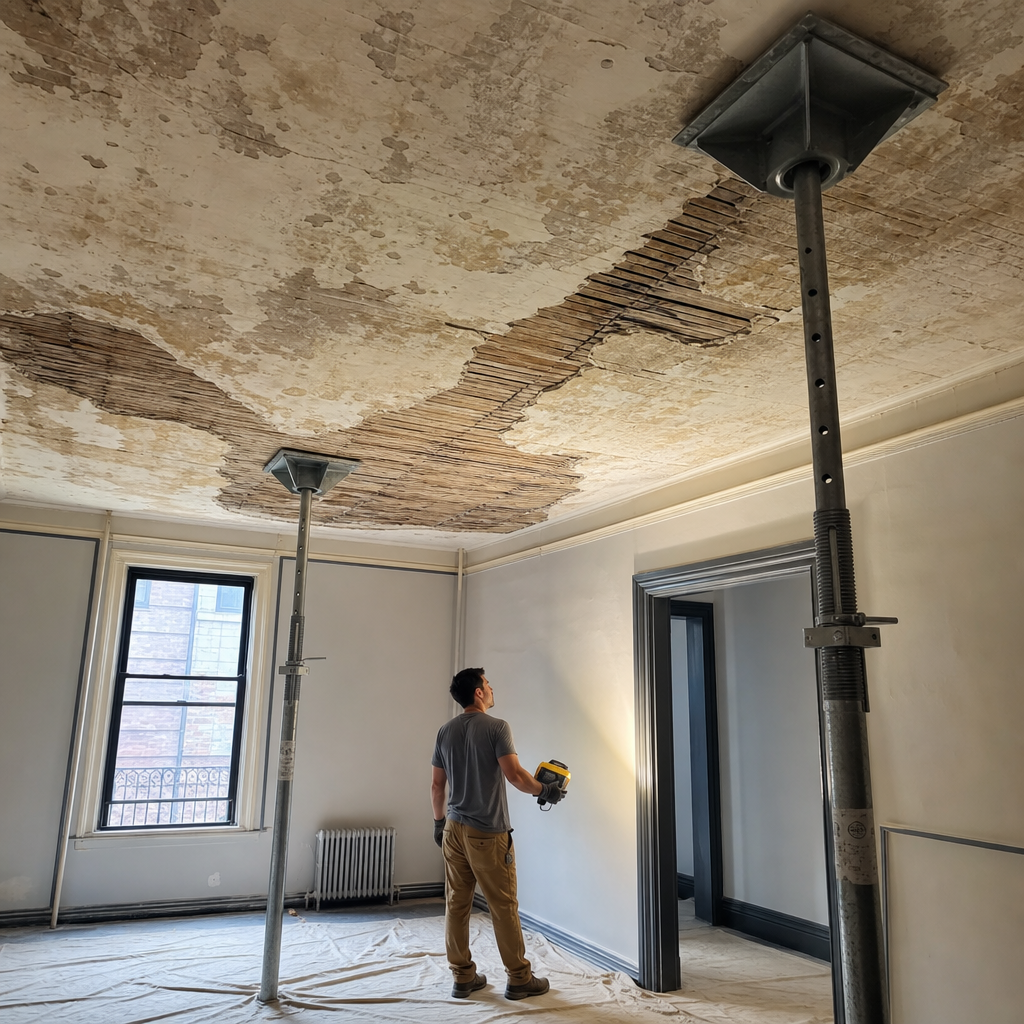
Many older multi-family buildings and rowhouses feature traditional plaster-and-lath ceilings. Applying standard drywall drying protocols to wet plaster ceilings creates a serious hazard: catastrophic delayed collapse.
Drywall behaves like a sponge. It sags quickly, shows obvious discoloration, and is designed to be cut out and replaced in clean sections. Plaster, however, is a composite system. Wet plaster keys – the mechanical nodules of plaster pushed between horizontal wooden lath strips – soften when exposed to standing water.
Because plaster is dense, it can hold immense amounts of water without showing severe surface staining immediately. While modern dehumidifiers might dry the visible surface of the ceiling, moisture remains trapped in the joist bay directly above the lath. Over the course of days or weeks, the weight of the water-logged plaster degrades the softened keys. Without warning, hundreds of pounds of solid plaster can sheer away from the wooden lath and collapse into the living space below.
Recognizing Plaster Failure Indicators
If your property has plaster ceilings, look for these specific failure warnings after an upper-floor leak:
- A hollow or spongy sound when gently pushing upward on the ceiling with your hand.
- Small hairline cracks expanding in spiderweb patterns around the perimeter of the damp area.
- Bulges that feel hard rather than soft (indicating water and debris pooling behind the plaster skin).
- Dust or fine grit filtering down through light fixtures or moldings.
Ceiling leaks can be documented in city enforcement records, though Astoria-specific statistics are not available. When addressing plaster ceiling leaks, technicians like those at Floodline Restoration Co. must determine whether to stabilize the plaster with specialized washers and cavity drying or safely remove the compromised section down to the joists.[3]
What Immediate Steps Should You Take When a Ceiling Leaks?
Need ceiling water damage repair in Astoria?
We’re available now - call for a fast, free estimate.
When an active leak hits your ceiling, following a structured process protects your property and establishes the necessary paper trail for your insurer.
-
Step 1: Eliminate Electrical and Safety Hazards
Shut off electricity to the impacted room at the main breaker box. Never touch or turn on light fixtures that show signs of water intrusion or dripping. Evacuate people and pets from directly beneath the wet ceiling area.
-
Step 2: Relieve Water Weight with a Controlled Puncture
Water pooling behind paint or drywall adds massive deadweight to the ceiling assembly. Place a wide bucket underneath the center of the sag and use a screwdriver or utility knife to pierce the middle of the bulge. This drains the water into a controlled container and prevents the ceiling from tearing open under stress.
-
Step 3: Document the Damage for Insurance
Before cleanup begins, capture detailed photos and clear video showing the leak source, ceiling damage, floor impact, and damaged furnishings. Keep all replaced plumbing parts or damaged components for the insurance adjuster’s inspection.
-
Step 4: Contact Water Damage Restoration Specialists
Hidden moisture inside joist cavities will not dry on its own through household fans. Restoration technicians at Floodline Restoration Co. deploy moisture meters, infrared cameras, and commercial desiccant or refrigerant dehumidifiers to draw water out of the structural wood framing before rot or mold take hold.
Frequently Asked Questions About Ceiling Water Damage
How fast can mold grow behind a wet ceiling?
Mold can begin to develop on damp building materials after moisture exposure. Trapped water in warm, unventilated ceiling cavities creates an environment for microbial growth, making fast extraction and structural drying essential.
Does New York homeowners insurance cover ceiling water damage repair?
Most New York homeowners insurance policies cover ceiling repairs if the water intrusion was sudden and accidental, such as a burst supply line, heating system failure, or a sudden fixture overflow from an upstairs unit. Damage caused by long-term, unresolved leaks or lack of building maintenance is generally not covered.
Can a water-damaged ceiling collapse if left untreated?
Yes. Water adds significant physical weight to building materials while breaking down the fasteners holding drywall or the mechanical keys holding plaster to wooden lath. If trapped water is not properly drained and dried, the ceiling assembly will eventually fail and fall.
How do technicians restore a water-damaged plaster ceiling versus drywall?
Drywall with significant water damage is typically cut out along the nearest framing joists, replaced with new moisture-resistant board, taped, and refinished. Plaster ceilings require structural assessment: if the plaster keys are still intact, technicians dry the joist cavity from above or via injection ports. If the keys are broken, the loose plaster must be systematically removed and replaced with modern backing and a multi-coat finish.
How long does the ceiling drying process take?
According to Floodline Restoration Co., the time required for structural drying varies depending on building material density, the volume of water, ambient humidity, and whether moisture has spread into surrounding assemblies.
Need ceiling water damage repair in Astoria?
We’re available now - call for a fast, free estimate.
Sources
- Fix a Leak Week | US EPA – epa.gov
- Water Damage Insurance Claims Statistics (2026) – consumeraffairs.com (2026)
- NYCHA residents voice their concerns at forum in Queens – cbsnews.com
Related reading: Water Damage Restoration in Upper West Side – 10% Off & Free Estimate – Same-Day Service
Related reading: Water Damage Restoration in Upper Manhattan | Call Now-10% Off | Same-Day Service | Free Estimate
Related reading: Water Damage Restoration in Ditmars Steinway | Call Now-10% Off | Same-Day Service | Free Estimate
Frequently Asked Questions
Who is responsible for paying for ceiling water damage caused by an upstairs neighbor in Astoria?
In New York multi-family properties and co-ops, responsibility typically falls on the upstairs resident if negligence caused the overflow, or the building management if a shared main pipe failed. Floodline Restoration Co. provides thermal moisture mapping and forensic damage documentation to help your insurance carrier or landlord clearly establish liability.
Can a historic plaster-and-lath ceiling be saved after an overhead water leak without tearing it down?
Yes, historic plaster ceilings can often be saved if the mechanical plaster keys have not detached from the wooden lath strips. Floodline Restoration Co. uses deep-cavity air injection systems and stabilization washers to dry the hidden joist bays from within, preserving historic architectural features while eliminating trapped moisture.
What should I do if water is leaking directly through an overhead light fixture or ceiling fan?
Immediately shut off electricity to that room at your main breaker panel to avoid electrocution or electrical fire hazards, and never touch the wet light switch. Once the power is isolated, contact Floodline Restoration Co.'s 24/7 dispatch line for an immediate 45-minute on-site emergency response in Astoria to safely relieve trapped water and stabilize the fixture.
About the author
 |
Christopher Vance Christopher Vance is a certified structural drying specialist with over nine years of experience in property damage restoration. He holds an associate degree in Construction Management from Pratt Institute and focuses on rapid-response water mitigation. Christopher writes to help Astoria property owners navigate the complexities of emergency restoration and insurance claims. |
Water damage, flood, or mold emergency?
We’re available now - call for a fast, free estimate.
Call Now - Free Estimate