
Quick Summary
When dealing with sudden flooding, securing rapid emergency water damage restoration in Astoria is essential to halt destructive moisture migration throughout historic pre-war rowhouses and multi-family walk-ups. Floodline Restoration Co. acts as a hyper-local authority equipped to stabilize complex building assemblies through rapid water extraction, precision moisture mapping across shared party walls, and thorough insurance documentation. Property owners will learn how to safeguard their structural integrity and can call Floodline's 24/7 Astoria dispatch for a 45-minute emergency response and a free visual inspection with a written scope of work.
Emergency Water Damage Restoration in Astoria: What to Do After Flooding
When a pipe bursts, a sewer line backs up, or stormwater surges into a basement, immediate action can help limit structural damage and repair costs. Finding emergency water damage restoration in Astoria requires a team like Floodline Restoration Co. that understands how to extract water quickly and assess different types of building materials when water intrudes.
Properties in the area include a mix of pre-war rowhouses, multi-family walk-ups, and commercial storefronts with varied building materials. Knowing what steps to take during a water emergency can help protect your property, your health, and your insurance claim. See also Water Damage Restoration in Astoria | Call Now-10% Off | Same-Day Service | Free Estimate.
How Fast Can Emergency Restoration Crews Arrive at Your Astoria Property?
Response times vary by location, traffic, weather, staffing, and the severity of the incident. Ask the provider to confirm its expected arrival time.
What Happens in the First 60 Minutes on Site
When technicians arrive at your property, immediate mitigation begins to halt water migration. The first hour focuses on stabilization:
- Hazard isolation: Technicians inspect the site for electrical risks, particularly in subgrade spaces where standing water reaches baseboard outlets, panel boxes, or submerged mechanical equipment.
- Moisture mapping: Using thermal imaging cameras and non-invasive moisture meters, the team traces hidden water paths through flooring, behind baseboards, and inside common walls.
- Bulk water extraction: High-powered truck-mounted or portable extraction units pull standing water from floors, carpets, and foundations to prepare the structure for controlled drying.
Immediate Safety Steps While Waiting for Dispatch
While waiting for an emergency crew, protect yourself and minimize damage with these steps if it is safe to do so:
- Shut off the main water valve: If the issue stems from an internal plumbing failure, turn off the main water supply immediately.
- Avoid electrical panels in wet areas: Do not walk through standing water to reach an electrical panel. If the breaker box is safely accessible in a dry area, shut off power to the affected rooms.
- Document the damage: Take clear, timestamped photos and video of standing water, waterlines on walls, and damaged personal property before anything is moved.
- Keep contaminated water isolated: If dealing with a sewer backup or street runoff, keep family members and pets away from the area to avoid exposure to harmful pathogens.
Drying Considerations for Older Building Materials
Need emergency water damage restoration in Astoria?
We’re available now - call for a fast, free estimate.
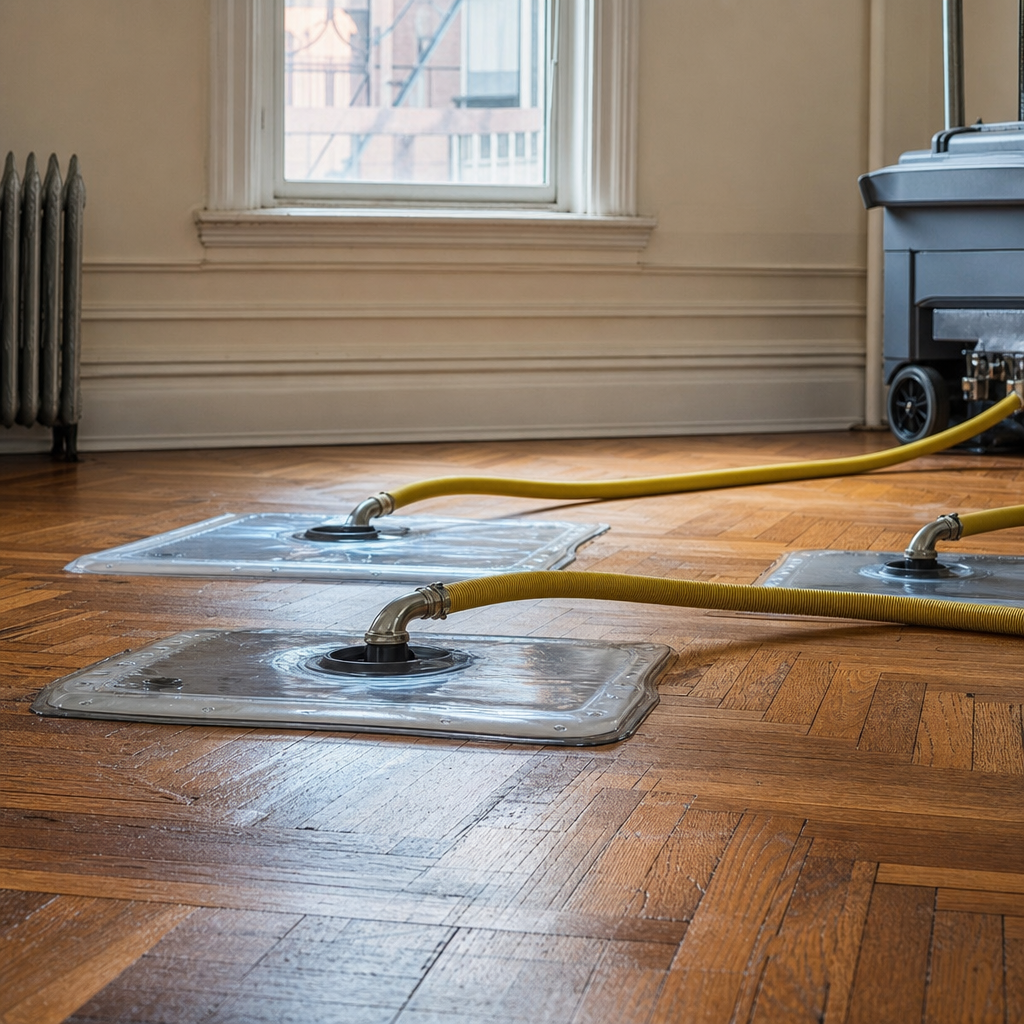
Older buildings and pre-war properties often feature materials such as plaster walls, continuous floor joists, and masonry foundations. Restoring these assemblies after water intrusion requires careful moisture monitoring and controlled drying methods appropriate for the specific materials present.
Proper restoration generally involves controlled airflow combined with dehumidification to remove moisture steadily. Restoration professionals like Floodline Restoration Co. evaluate the structure to determine whether materials can be dried in place or require removal.[5]
Addressing Moisture in Plaster, Wood, and Masonry
Plaster and wood assemblies absorb moisture differently than modern drywall. When water penetrates these materials, restoration professionals assess the humidity and moisture levels in the structure, adjusting equipment to promote steady evaporation. Wood subfloors and finished flooring also require professional evaluation to determine the most effective drying or remediation approach.
Addressing Moisture in Shared Walls and Subgrade Spaces
According to New York City Emergency Management, subgrade spaces exist in roughly 43% of all buildings across the city, and more than three-quarters of the approximately 358,000 buildings with subgrade spaces are located in Brooklyn and Queens. During major rain events, these spaces are especially vulnerable.[2]
Data from Tropical Storm Ida revealed that Queens sustained the most reported building damage among boroughs, with heavy concentrations in neighborhoods such as East Elmhurst, Jackson Heights, Elmhurst, Forest Hills, and Kissena Park. Notably, NYC Emergency Management reported that 51.8% of the 17,357 impacted buildings were outside FEMA floodplains. Even if your property is not in a designated high-risk flood zone, subgrade runoff and sewer surcharges remain substantial threats.[1]
In attached rowhouses and multi-unit buildings, water does not stay within property lines. Continuous wood joists and shared brick party walls allow moisture to travel sideways into neighboring units. Restoration teams, including Floodline Restoration Co., must check common cavities to verify that dampness is not moving into adjacent structures, which can lead to concealed rot and microbial growth.
Component Evaluation: Floors, Ceilings, and Basement Assemblies
A qualified professional evaluation helps determine what can be dried in place and what may need removal:
- Hardwood and subflooring: Solid wood may sometimes be dried and restored depending on the extent and duration of moisture exposure, whereas subfloors that have suffered structural degradation or delamination may require replacement.
- Plaster vs. drywall ceilings: Saturated ceilings may pose safety hazards. Drywall that has lost structural integrity generally requires removal, while some plaster assemblies might be dried if structurally intact, as evaluated by qualified professionals.
- Porous basement materials: Concrete and masonry foundations can absorb water and contaminants. These areas typically require extraction, professional cleaning, and thorough drying.
What Does Emergency Water Damage Restoration Cost in Astoria?
Restoration costs depend directly on the scope of the emergency. Key variables include the water source category (clean supply line, gray water from an appliance, or black water from a sewer backup), the square footage affected, the structural materials involved, and how long the water has been sitting.[4]
A minor clean-water pipe leak confined to a single room costs far less to remediate than a multi-floor sewage backup that has penetrated shared party walls and basement concrete. The Comptroller identified Queens Community Districts 12 and 5 among areas with high concentrations of basements and cellars, but the cited data does not establish an Astoria-specific flooding rate. For an accurate quote, always request a detailed on-site assessment and a written scope of work before structural demolition starts.[3]
Navigating Insurance Claims and Coverage
Coverage depends on the cause of damage and policy terms. Standard homeowners and renters policies typically do not cover flood damage, while certain water-backup or sewage losses may require an endorsement and flooding may require separate flood insurance. Policy terms should be confirmed with the insurer.
To support your claim, your restoration contractor, such as Floodline Restoration Co., should provide comprehensive documentation, including daily moisture logs, atmospheric readings, thermal images, and itemized inventories of non-salvageable materials.
Frequently Asked Questions About Emergency Water Restoration in Astoria
Does insurance cover water damage cleanup in Queens properties?
Coverage depends on the cause of damage and policy terms. Standard homeowners and renters policies typically do not cover flood damage, while certain water-backup or sewage losses may require an endorsement and flooding may require separate flood insurance. Policy terms should always be confirmed with the insurer.
How do professionals prevent mold growth after a flood?
Prompt drying can help limit additional damage and microbial growth. Restoration professionals at Floodline Restoration Co. mitigate growth risks by extracting bulk water promptly, applying EPA-registered antimicrobial treatments when appropriate, and operating commercial dehumidification equipment until materials reach acceptable moisture levels.
Are emergency water extraction services available 24/7 across Queens and Astoria?
Availability varies by company. Property owners should verify emergency availability directly with the provider. Prompt water extraction after discovering a leak or flood can help limit overall restoration costs.
Need emergency water damage restoration in Astoria?
We’re available now - call for a fast, free estimate.
Sources
- NYCEM Copy to Edit_Ida Damage Analysis Report [SHAREDwithJP] – nyc.gov (2021)
- CDBG-DR – nyc.gov
- Bringing Basement Apartments Into the Light – Office of the New … – comptroller.nyc.gov
- [PDF] Bringing Basement Apartments Into the Light – comptroller.nyc.gov
- P-2333 New York City: Effects of Hurricane Ida – fema.gov
Related reading: Water Damage Restoration in Upper Manhattan | Call Now-10% Off | Same-Day Service | Free Estimate
Related reading: Water Damage Restoration in Ditmars Steinway | Call Now-10% Off | Same-Day Service | Free Estimate
Related reading: Water Damage Restoration in Midtown West | Call Now-10% Off | Same-Day Service | Free Estimate
Frequently Asked Questions
How do restoration specialists treat water traveling through shared party walls in Astoria rowhouses?
Because continuous floor joists and porous brick party walls allow moisture to spread between adjoining Astoria buildings, Floodline Restoration Co. uses non-invasive thermal imaging to inspect shared structural cavities. Technicians then deploy targeted cavity-drying injection equipment and commercial dehumidifiers to halt structural decay and microbial growth without unnecessary demolition.
What happens during Floodline Restoration Co.'s initial 45-minute emergency response in Astoria?
Upon arrival, Floodline Restoration Co. immediately isolates electrical hazards in subgrade or flooded areas and performs digital moisture mapping across flooring and wall assemblies. The crew then begins high-volume bulk water extraction and delivers a free visual inspection with a written scope of work before setting up controlled structural drying.
What insurance documentation does Floodline Restoration Co. provide for flooded Queens properties?
Floodline Restoration Co. compiles a comprehensive documentation package containing timestamped thermal imaging, daily moisture logs, atmospheric drying records, and an itemized inventory of unsalvageable materials. This verifiable data helps policyholders substantiate claims under standard policies, sewer-backup endorsements, or commercial coverage.
About the author
 |
Christopher Vance Christopher Vance is a certified structural drying specialist with over nine years of experience in property damage restoration. He holds an associate degree in Construction Management from Pratt Institute and focuses on rapid-response water mitigation. Christopher writes to help Astoria property owners navigate the complexities of emergency restoration and insurance claims. |
Water damage, flood, or mold emergency?
We’re available now - call for a fast, free estimate.
Call Now - Free Estimate