
How to Choose the Right Damage Restoration Company in Astoria
The right damage restoration company in Astoria is the one that carries the job from the first extraction through the final coat of paint with the same licensed crew, bills your insurance carrier directly, and puts its workmanship guarantee in writing with specific terms. The wrong one hands the rebuild off to a subcontractor you never vetted and leaves you managing two contractors, a confused adjuster, and a timeline that slips for months. If you’d rather not sort through contractors after a flood or fire, call us at (518) 800-3751 and we’ll walk you through exactly what you’re dealing with.
We’ve spent 42 years in this trade, and the most common complaint we hear from New York homeowners isn’t that the work was bad. It’s that the company that extracted the water wasn’t the same company that did the rebuild, and somewhere between those two handoffs, responsibility for the result disappeared entirely. That’s the problem this checklist solves.
Key Takeaways
- Ask one contract question before anything else: does the same licensed crew handle extraction, drying, and rebuild, or does the company subcontract reconstruction?
- Verify IICRC certifications by name and number, not by the word “certified” on a van door.
- In Astoria’s humid summers, commercial-grade drying equipment owned by the contractor matters more than a low line item on an estimate.
- A written guarantee needs three things to be enforceable: a coverage period, named failure conditions, and a dispute process.
- Direct insurance billing keeps you out of the carrier negotiation, which is where most homeowners lose weeks.
The Contract Question That Eliminates 90 Percent of Bad Hires
Before you look at a single line item on an estimate, ask this: “Who does the rebuild?” A full-cycle restoration company like Floodline Restoration Co. keeps the job whole, from the water line on the drywall to the finished trim. The same project manager who reads the moisture map on day one hands you the drying log on day ten and schedules the drywall crew on day fourteen. There is no handoff, and more importantly, there is no moment where the person responsible for the result changes.
Most restoration contractors in Astoria don’t work that way. They extract the water, dry the structure, and then hand you a referral to a general contractor they’ve “worked with before.” That referral isn’t a guarantee of anything. If the rebuild goes sideways, the extraction company says the rebuild wasn’t their scope. The general contractor says the drying wasn’t done right. And you, the homeowner, are standing in a gutted living room holding two phone numbers and no leverage. Get the answer in writing before you sign: a single contract that names the company responsible for every phase, through the final walkthrough.
IICRC Certifications: What the Letters Actually Mean
The Institute of Inspection, Cleaning and Restoration Certification is the standard-setting body for this industry, and its credentials are specific. A Water Damage Restoration Technician certificate, or WRT, means the technician has completed training on extraction methods, drying science, and contamination categories. An Applied Structural Drying certificate, or ASD, is different, and it matters more in Astoria’s climate. ASD-certified techs are trained to calculate drying chamber requirements and use psychrometrics to determine when a structure has actually reached its dry standard, not just when the visible water is gone.
Here’s how to verify a certification claim in two minutes. Ask the company for the technician’s name and certification number. Then search that number on the IICRC registry at iicrc.org. If the company says “our techs are certified” but won’t give you a name or a number, press harder. In our experience, that usually means one person on the crew holds a certificate from eight years ago and everyone else is untrained. We post our techs’ IICRC, RIA, and IFA training on job paperwork because a certification you can’t verify is a marketing slogan. Certification you can check is a credential.
Equipment: The Difference Between Owned and Rented Is a Timer
Astoria summers run hot and humid, and humidity is the enemy of dry. When a company extracts water from a finished basement in July, the building materials leave the flood with a certain moisture content. The goal is to get that number down to the dry standard before mold gets a foothold, which in a humid environment gives you a narrow window, often 48 to 72 hours. The equipment that determines whether you hit that window is the drying array: LGR dehumidifiers, which pull moisture out of the air at low grain levels, and air movers, which push dry air across wet surfaces.
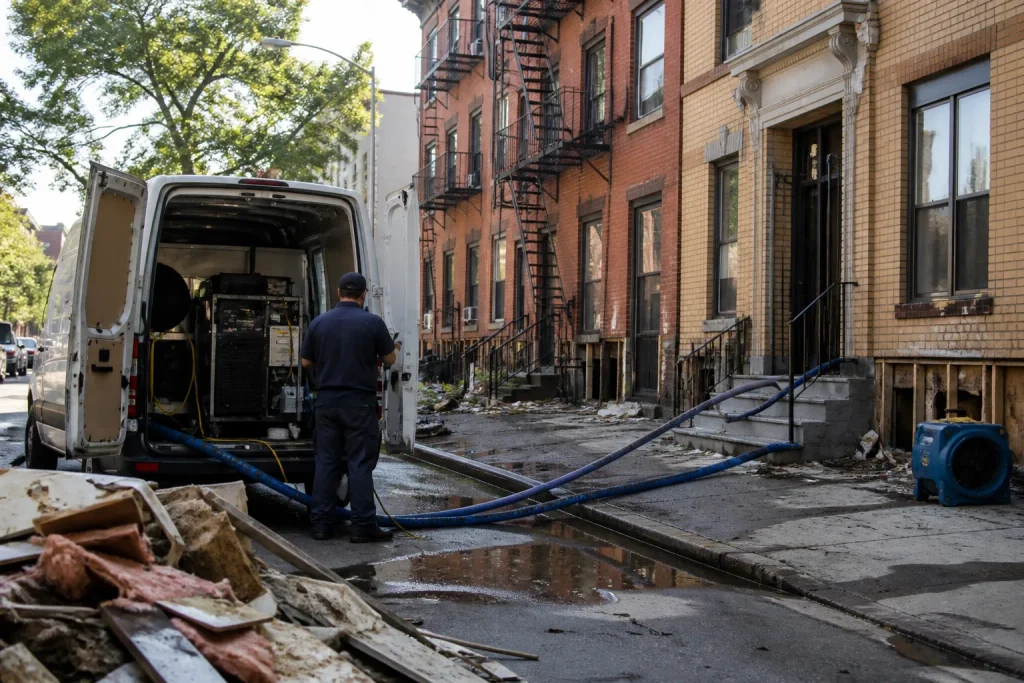
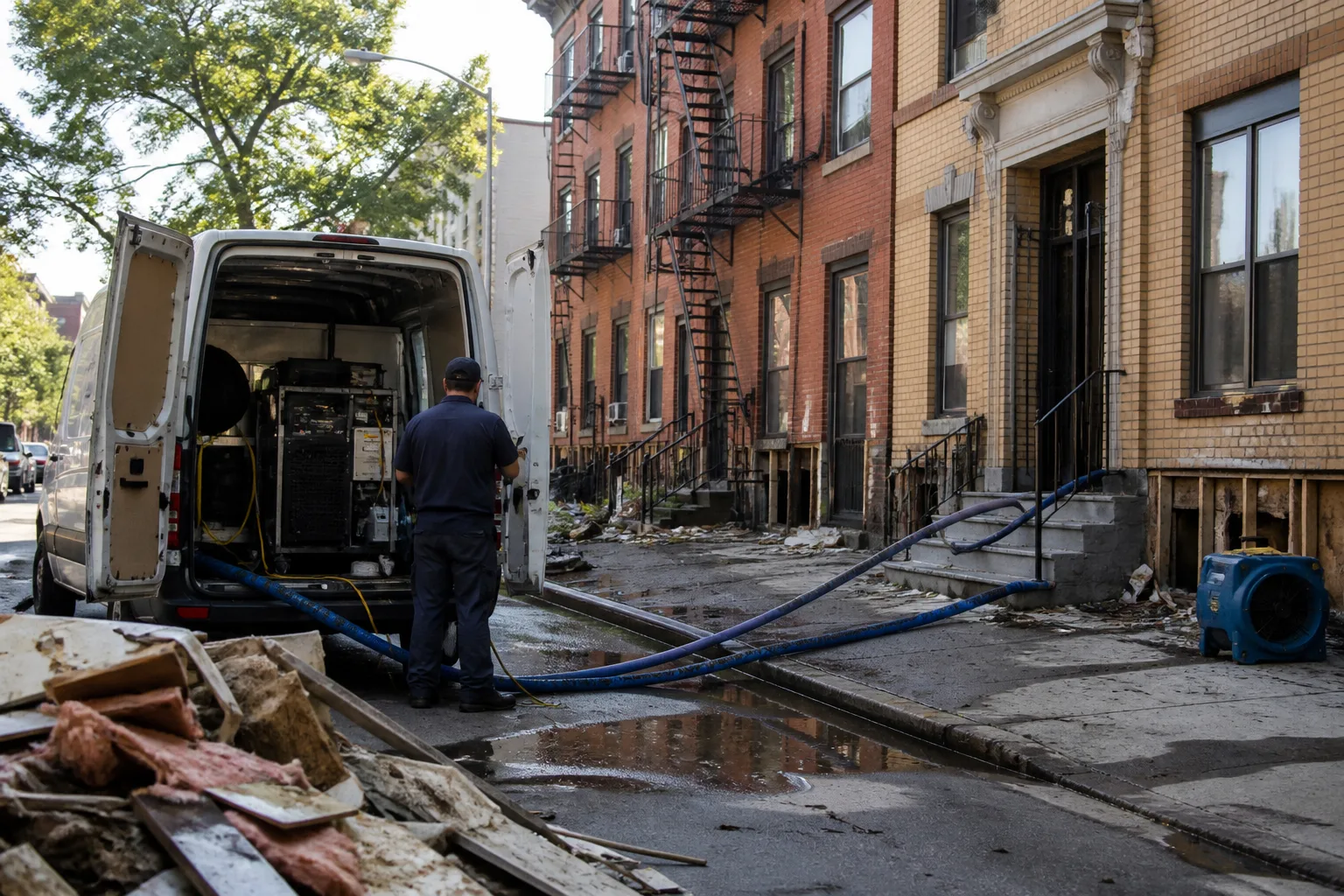
Here’s the difference that doesn’t show up in a Google search. A company that owns its drying equipment, commercial-grade units like Dri-Eaz and Phoenix, has enough capacity on hand to run a proper drying array on day one. A company that rents residential units from a big-box store arrives with whatever the store had in the back corner and charges you the rental markup. We run professional-grade Dri-Eaz, Phoenix, XPOWER, B-Air, and Injectidry equipment because we own it and test it between jobs. When a technician is taking daily moisture readings and logging them for you and your carrier, the log only means something if the equipment behind it can actually dry the structure. Ask the company what brand of dehumidifiers they run and how many they own. If they can’t answer, that’s an answer.
Insurance Billing: The Red Flag Hiding in Plain Sight
After a flood or fire in Astoria, your insurance carrier is going to be involved. The question is whether you’re the one negotiating with them. Here’s the red flag that should end a conversation: a contractor who asks you to pay the full bill upfront and “get reimbursed later.” What that means is you’ve become the general contractor’s bank, and the adjuster’s negotiation is now your problem. If the carrier disputes a line item, you eat the difference. If the claim gets delayed, you’re carrying the balance on a credit card.
The alternative is direct insurance billing, where the restoration company submits its documentation to the carrier, negotiates the scope directly, and gets paid by the carrier. We’ve been doing this in Astoria long enough to know that a direct-billing model removes the single biggest source of homeowner stress in the whole process. Photo documentation, daily moisture logs, and a written scope all go to the adjuster from us, not through you. You get a copy of everything, but you don’t have to be the messenger. If a company tells you that you need to pay first, ask why their work isn’t good enough to stand up to an adjuster’s review. If they don’t have an answer, get another company.
What a Written Guarantee Actually Needs to Say
“We stand behind our work” is a phrase that binds nobody to anything. A workmanship guarantee that actually protects you has three components, and if any of them is missing, the guarantee is a paragraph of warm language on a sales sheet. First, a specific coverage period. Ours is the 90-Day Done Right Promise, and it’s in writing, not something a salesperson mentioned. If it’s not done right, we make it right. No arguing, no paperwork battles, no “that was within our tolerance.”
Second, named failure conditions. The guarantee has to say what “not done right” means in practice: a drywall seam that opened, a floor that cupped after drying, a paint line that failed. Third, a dispute process. There has to be a path for you to say “this isn’t right” and know what happens next. Ours is straightforward: you call us, we send a supervisor, and we fix it. That’s the Keystone Standard, and it’s tied to the same values code we’ve run the company by since 2010. When you’re comparing companies in Astoria, ask to see the actual language of the guarantee before you sign. If it isn’t in writing, it isn’t real.
How to Evaluate a Restoration Company in Astoria: A Working Checklist
We pulled a sump pump out of a basement on Ditmars Boulevard last month that had been installed by a handyman who was “recommended by a neighbor.” The pump was wired into an extension cord stapled to a floor joist. The homeowner had paid half up front, the handyman had disappeared, and the basement had three inches of water in it by the time we got there. This checklist exists so that doesn’t happen to you.
- Ask who does the rebuild. Get the answer in writing on the contract.
- Ask for IICRC certification numbers, not just the word “certified.” Verify them on the IICRC registry.
- Ask what brands of dehumidifiers and air movers the company owns. Commercial names like Dri-Eaz and Phoenix matter.
- Ask how insurance billing works. Direct billing means you stay out of the negotiation.
- Ask to see the written workmanship guarantee before signing. It needs a term, named failure conditions, and a dispute process.
- Ask who answers the phone at 2 a.m. We have a live dispatcher, not a recording, every hour of every day. If you can’t reach a person in an emergency, the company’s response time is a marketing claim.
When to Call a Pro
Here’s the honest version. If the water line on your wall is above the baseboard, or the water came from a sewage line or a storm drain, this is not a shop-vac job. Category 2 and Category 3 water carries contaminants that require specific extraction procedures and antimicrobial treatment. If you’ve had standing water for more than 24 hours, mold is likely already starting in the wall cavity. And if the fire department was in your house, the smoke residue has worked its way into surfaces that look clean. In any of those situations in Astoria, call a restoration company before you call a painter. Related services: Water Damage Restoration in Astoria, Mold Remediation in Astoria, and Fire & Smoke Damage Restoration in Astoria.
The Bottom Line
Choosing a restoration company in Astoria isn’t about the lowest bid. It’s about finding a company that finishes what it starts, owns its equipment, stands behind its work in writing, and keeps you out of the carrier negotiation. Check the certifications by name and number. Verify the equipment. Read the guarantee language before you sign. And if the company can’t answer the simple question of who does the rebuild, find one that can. If you’re in Astoria and need help after water, fire, sewage, or mold, Floodline Restoration Co. offers free estimates with a live person on the phone at (518) 800-3751.
Frequently Asked Questions
Ask for the technician’s name and certification number, then verify it on the IICRC registry at iicrc.org. A real credential can be checked in two minutes. “Certified” on a van door with no name, no number, and no way to verify it is a marketing claim, not a certification. Call us at (518) 800-3751 and we’ll give you our techs’ numbers right over the phone.
Most homeowners policies in New York cover sudden and accidental water damage, fire, and storm damage, minus your deductible. Mold remediation coverage varies by policy and often depends on whether the mold resulted from a covered event. The cleanest path is direct insurance billing, where the restoration company submits its documentation to your carrier and negotiates the scope directly. Call (518) 800-3751 and we’ll help you figure out what your policy actually covers.
If you call at 2 a.m., you should talk to a person, not a recording. We run live dispatch 24 hours a day, every day of the year, and a certified crew can reach most homes in Astoria the same visit. Extraction starts that visit, because the water keeps doing damage every hour it sits. Call (518) 800-3751 and a live dispatcher will get a crew moving.
If the water is clean, the area is small, and you can dry it fully within 24 hours, maybe. But for sewage backups, storm water, standing water, or anything that sat for more than a day, the contamination and moisture load require commercial equipment and antimicrobial treatment. The expensive damage is what’s going on inside the wall cavity where you can’t see it. Call (518) 800-3751 for an honest assessment of what you’re dealing with.
Written by Curt Bowman, Owner at Floodline Restoration Co., serving Astoria since 2010.
Need Damage Restoration Help?
Call Floodline Restoration Co. - licensed & insured, here with fast after-hours help in Astoria.
(518) 800-3751