
Phoenix Water Damage Restoration in Astoria: A Homeowner’s Guide
Water damage restoration in Astoria costs between $1,800 and $6,500 for a typical single-room incident in a pre-war building, with full-unit rebuilds running higher depending on what the moisture reached before anyone found it. The work is not just pulling out wet drywall; it is confirming with moisture meters that the studs, joists, and the century-old cavities behind plaster are dry before anything gets closed back up. If you would rather not ride out the drying timeline alone, call Floodline Restoration Co. at (518) 800-3751 and a live dispatcher will answer, day or night.
Most homeowners in Astoria start their search the moment the ceiling stains or the floor buckles. What they do not yet know is that the water they can see is the smallest part of the problem. The visible stain is the floodline. Everything below and behind it tells the real story.
Why Water Behaving Badly in Astoria Is Different Than Anywhere Else
Astoria has one of the highest concentrations of attached brick rowhouses and pre-1940 multi-family buildings in Queens. These buildings share walls, share floor joists, and often share the same balloon-frame wall cavities that run continuously from the basement to the roof. When a pipe lets go on the third floor of a converted two-family on 28th Avenue, the water does not stop at the ceiling below. It drops down inside the wall chase, finds the old knob-and-tube access holes, and runs sideways along floor plates until it pools above the basement ceiling a hundred feet from the source.
In our experience in Astoria, the moisture travels farther in these buildings than in newer wood-frame or concrete construction. The framing is old-growth lumber, hard and dense, so it does not warp or stain as quickly, which means it hides water damage for longer. The plaster walls were mixed with horsehair and lime, which slurps up moisture and holds it like a sponge against the lath behind. A standard drying timeline that works in a 1990s sheetrock house in Long Island underestimates what a pre-war Astoria apartment needs by two or three days, sometimes more.
What homeowners need to know: do not accept a verbal “it feels dry.” Moisture must be measured, logged, and confirmed against a documented dry standard before any rebuild starts. We hand the homeowner and the carrier a moisture log with daily readings, so nobody is guessing, and we can revisit this later because it matters when the mold question comes up.
How Water Moves Through Pre-War Brick and Balloon-Frame Buildings
Understanding the path water takes in Astoria’s housing stock is the difference between a complete restoration and a recurring nightmare. Here is how it works in a typical attached brick rowhouse or pre-war apartment building.
- The vertical chase. In balloon framing, the wall studs run uninterrupted from the foundation to the attic. There are no fire blocks, no horizontal barriers. Water entering on the top floor can travel vertically for three or four stories through the same cavity, then pool wherever the floor plate creates a slight dam.
- The shared party wall. In Astoria’s attached brick buildings, the side walls are literally shared with the neighbor. A leak on your side of the party wall can wick through the common masonry and appear as paint bubbling on the other side. This creates liability exposure that single-family restoration guides never mention. You need photos, moisture readings, and a written scope that documents where the water started and where it traveled, especially when dealing with an insurance claim that may involve the adjacent unit.
- Old plumbing chases. Many pre-war buildings in Astoria had plumbing retrofitted in the 1950s and 60s, run through notched joists and unsealed chase openings. When these fail, water follows the notches and the gaps, often emerging two rooms away from the actual leak. A restoration crew that only dries the wet spot misses the whole path.
- Basement floor assemblies. Astoria basements are frequently below the sewer line, which is why sewage backup is a real issue on the low streets near the East River and in the Ditmars area. Water that reaches the basement can sit in floor assemblies where joists meet the foundation, hidden by old vinyl tiles or carpet, until the musty smell gives it away.
Every one of these paths adds drying time and requires the right equipment. A high-ceiling pre-war apartment with 10-foot walls holds far more cubic footage than a modern 8-foot unit, which means a restoration company needs commercial-grade dehumidifiers rated for that volume, not portable units from a rental counter. Before you sign anything with any Astoria restoration company, ask what capacity dehumidifiers they carry in LGR (low grain refrigerant) ratings, and whether they map the moisture readings with a thermal camera and pin- or radio-frequency meters. Companies using professional-grade Dri-Eaz and Phoenix equipment can show you the readings on day one and every day after, until the dry standard is met.
The Restoration Phases, In Order, Explained Like a Real Job
A complete Astoria water damage restoration follows a sequence. Skipping or shortchanging any phase is where the horror stories come from. Here is what a full-cycle job actually looks like when done by the same crew from first extraction to finished rebuild.
- Extraction. Standing water is removed with truck-mounted or professional-grade portable extraction units. Time matters here. Water that sits in an Astoria pre-war building for 48 hours is already wicking into plaster and flooring, and that is when the real damage begins. On emergency calls, our dispatcher gets a crew there the same visit, and extraction is running before the homeowner has finished clearing the room.
- Containment and demolition of unsalvageable materials. Wet drywall, soaked insulation, and buckled flooring get removed to expose the framing. In a shared-wall building, containment is also a courtesy and a liability protection: plastic barriers and negative air pressure keep dust and any spores from migrating into the neighboring unit.
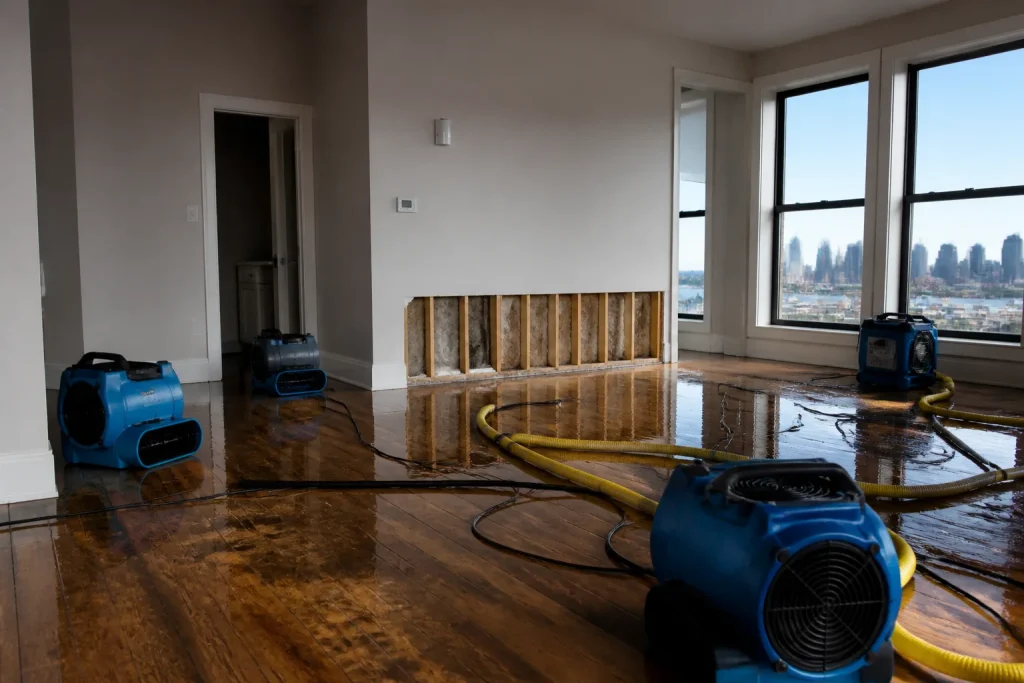
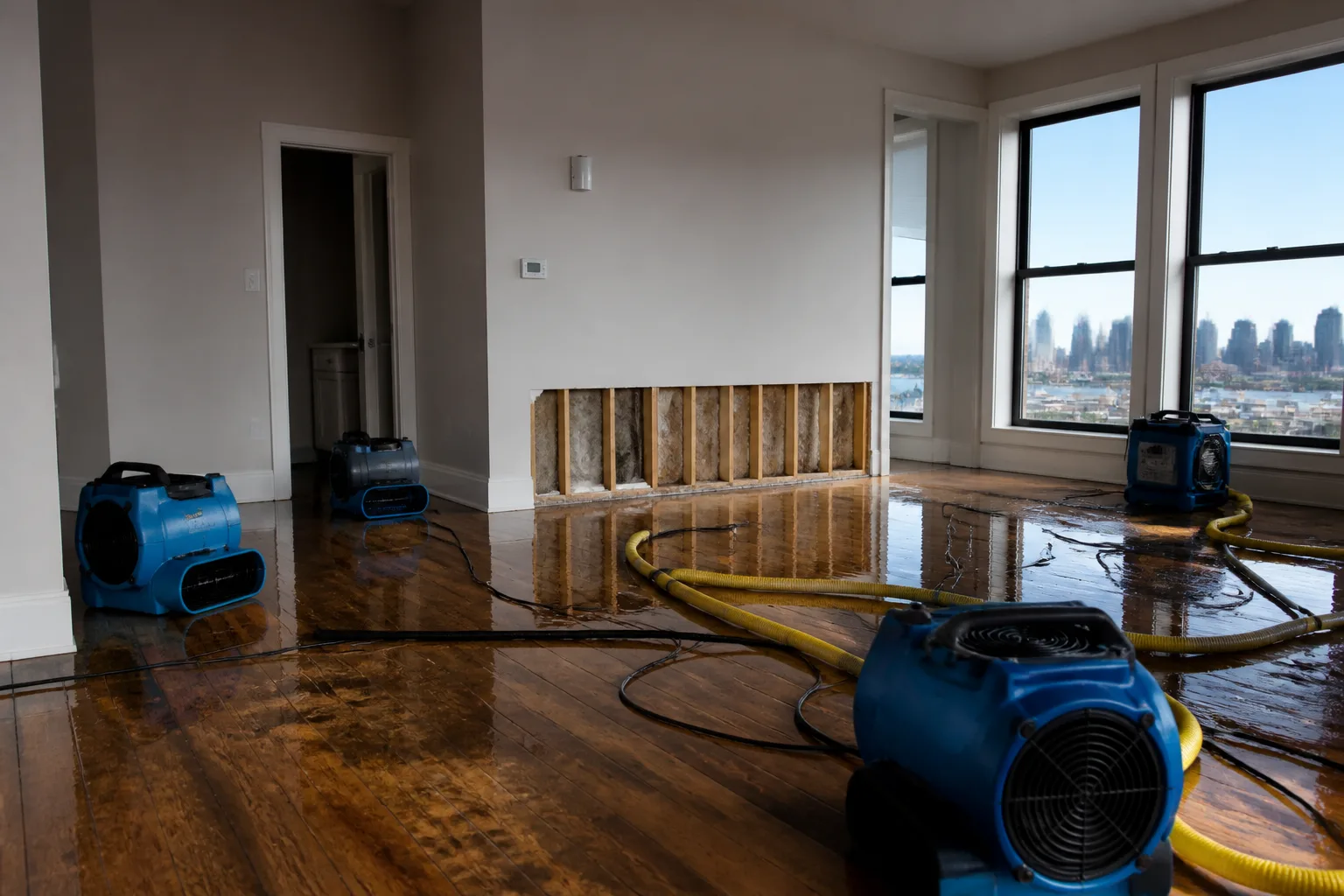
- Structural drying. This is the phase most often rushed. Commercial dehumidifiers and high-velocity air movers run for days, not hours. Daily moisture readings are taken from the studs, the floor assembly, and the surrounding drywall. The dry standard is typically below 15% wood moisture equivalent for framing, but the exact target depends on the material and the building. We record every reading and hand the log to the homeowner and the carrier. If a company cannot produce that log, they are asking you to take their word on a promise they may not be able to keep.
- Rebuild. New drywall, plaster repair, flooring, paint, and trim. The same crew that read the moisture map on day one does the rebuild, which means nobody is guessing what was removed or why. This is the part where many restoration companies hand the job off to a subcontractor, and the homeowner becomes the project manager. Full-cycle means the crew that extracted also frames, hangs, tapes, and finishes, and the foreman on site knows what the moisture profile was in every wall cavity.
We pulled one job out of a pre-war co-op on Crescent Street last month where the owner had been told by a previous company that the job was dry after three days. The baseboards had been reinstalled over framing that still read 30% moisture. The wood was quietly rotting behind the trim, and the only reason we found it was that our moisture map said the wall was not remotely close to done. He had called us because the paint was bubbling again, and he could not understand why.
What Documentation You Need Before Work Starts in a Multi-Unit Building
Astoria’s housing stock is dense, attached, and often governed by co-op boards, condo associations, or landlords with very specific ideas about liability. If you live in a multi-unit building and water damage starts in your unit or the one above you, the burden of proof will land somewhere, and without documentation, it lands on you.
Before any restoration work starts, you need:
- Photographic evidence of the source. Not just the damage, but the actual pipe, appliance, or roof penetration where the water entered.
- Moisture readings from the initial assessment. These should be taken with calibrated meters and recorded in a log. If the water came from the unit above, you want the first readings from your ceiling and walls documented before the neighbor’s insurance adjuster can argue the damage was pre-existing.
- A written scope of work. Every phase, every day of drying, every material to be replaced, stated in writing before work begins. Floodline Restoration Co. does this on every job, and we encourage homeowners to demand it of anyone they hire. A square deal means no surprises on the bill, and a written scope is the only way to guarantee that.
- Daily moisture log updates. The drying process is not a single event. The log shows the trend line. It is the document that proves the job was done right, and it is what protects you later if a mold question arises six months down the road.
Shared-wall and multi-unit buildings in Astoria add layers of exposure that single-family guides never address. You need restoration crews that have worked in these buildings before, understand party-wall dynamics, and know how to handle a co-op board’s insurance requirements without making the homeowner the middleman. We bill carriers directly on covered losses, so the homeowner is not chasing adjusters and faxing paperwork back and forth. That is our job.
Questions Every Astoria Homeowner Should Ask Before Signing Anything
If you are standing in a wet kitchen on 35th Avenue at 2 a.m., you want someone on the phone who can dispatch a crew, not a voicemail that promises to call back in the morning. Floodline Restoration Co. answers calls with a live person 24 hours a day, seven days a week, because water damage does not wait, and neither should you.
Once the crew is on site, here are the questions that separate a real restoration company from a cleanup crew with a fan:
- “What is your equipment capacity for this cubic footage?” A pre-war Astoria apartment with high ceilings needs LGR dehumidifiers rated for that volume. Ask to see the specs. Companies running professional-grade Dri-Eaz, Phoenix, XPOWER, B-Air, and Injectidry equipment can answer that question without hesitation.
- “Will your technicians be background-checked and uniformed?” You are letting strangers into your home at the worst possible moment. We background-check and uniform every technician who walks through your door, and we train them to IICRC, RIA, and IFA standards. That is not a sales pitch; it is a basic safety requirement for the people standing in your living room at midnight.
- “Who handles the insurance carrier?” If the answer is “you do,” keep looking. A full-cycle restoration company coordinates directly with the adjuster, provides photo documentation, and bills the carrier on covered losses. The homeowner should never play messenger.
- “What is your written guarantee?” A real company stands behind the work in writing, not verbally. Floodline Restoration Co. puts the 90-Day Done Right Promise in writing on every job. If it is not done right, we make it right. No arguing, no paperwork battles, no waiting on hold. We call it the Keystone Standard, and it is non-negotiable.
Water damage restoration in Astoria is not a commodity. The building you live in was built before anyone imagined moisture meters or LGR dehumidifiers, and the water inside those walls does not behave the way a modern textbook says it should. You need a crew that knows the difference between a balloon-frame cavity and a modern stud bay, and that will show you the readings to prove the job is actually done.
If you have questions about mold, fire, or storm damage, our Water Damage Restoration in Astoria page explains the full cycle, and Mold Remediation in Astoria covers what happens when hidden moisture turns into a real problem. We also handle Fire & Smoke Damage Restoration in Astoria, and you can always start at the Floodline Restoration Co. home page to see the full scope of what we do.
The Bottom Line
Water damage in Astoria’s pre-war brick and balloon-frame buildings is not a simple dry-and-patch job. The water travels through century-old cavities, shared party walls, and high-ceiling spaces that require professional-grade drying equipment and daily moisture documentation. The homeowners who fare best are the ones who ask for a written scope, demand a moisture log, and hire a company that handles the insurance carrier directly.
If you’re in Astoria and need help, Floodline Restoration Co. offers free estimates. We answer the phone with a live person, 24/7, at (518) 800-3751. We’ve been serving local communities for over 42 years, and we plan on being here in thirty more. Done right, and backed in writing.
Written by Curt Bowman, Owner at Floodline Restoration Co., serving Astoria since 2010.
Frequently Asked Questions
Water damage restoration in Astoria typically costs between $1,800 and $6,500 for a single-room incident in a pre-war building. Full-unit rebuilds run higher depending on how far the moisture traveled and what materials need replacement. Call (518) 800-3751 for a free, no-hassle estimate with a written scope before work starts.
A pre-war Astoria apartment with plaster walls and high ceilings typically takes three to five days of professional structural drying, sometimes longer, depending on the path the water took and the cubic footage of the space. Standard drying timelines used for modern sheetrock homes often underestimate these buildings by two or three days. A daily moisture log confirms when the dry standard is met.
Most homeowner policies cover sudden and accidental water damage, but coverage depends on the source and your specific policy. Floodline Restoration Co. coordinates directly with your insurance carrier, provides photo documentation, and bills the carrier on covered losses so you are not the one chasing adjusters. Call (518) 800-3751 and we’ll help you understand what your policy covers.
In a pre-war Astoria building, no. Water wicks into plaster, lath, and old-growth framing where portable fans and rental dehumidifiers cannot reach. Framing left above 15% moisture equivalent will eventually rot or grow mold behind the walls. Professional-grade equipment with daily moisture readings is the only way to confirm the job is actually dry before anything gets closed back up.
Floodline Restoration Co. has a live dispatcher answering the phone 24/7, and a certified crew reaches the job the same visit. Extraction is running that same day, because the longer water sits in a pre-war building, the deeper it wicks into the structure. Call (518) 800-3751 any time, day or night, and a real person picks up.
Need Damage Restoration Help?
Call Floodline Restoration Co. - licensed & insured, here with fast after-hours help in Astoria.
(518) 800-3751