
Water Damage Restoration Pricing Breakdown: What Astoria Homeowners Pay in 2026
Water damage restoration in Astoria typically runs between $2,200 and $7,800 for a contained single-room event like a burst supply line or water heater failure. A full basement flood with sewage, saturated drywall, and structural drying commonly lands between $9,000 and $18,000. Multi-floor pipe failures requiring demolition and rebuild of finished spaces can push past $28,000. The gap between those numbers has less to do with the size of the puddle than with what the water touched before anyone opened a wall. If you’d rather not work through this line by line yourself, call Floodline Restoration Co. home at (518) 800-3751 and we’ll walk a certified estimator through it with you.
We’ve been doing this in Astoria since 2010, and the estimate problem hasn’t changed much in fifteen years. A homeowner gets three quotes. One is flat-rate and low. One is time-and-materials and vague. One opens the wall, finds what the other two missed, and comes back with a number that makes everyone uncomfortable, because it’s honest. This post explains how to tell which is which before you sign anything.
What Actually Drives the Cost: A Line-by-Line Breakdown
Every water damage estimate in Astoria, whether it’s $2,000 or $25,000, should break down into the same five phases. If a quote doesn’t show these lines, ask for them. Contractors who bury demolition inside a vague “labor” line are usually hiding something, either a lowball that becomes a change order later or a padded number they can’t defend.
Here’s what we tell homeowners to expect on a 2026 Astoria job, using current Queens-market ranges. These reflect what our estimators quote and what we see on competitor invoices that pass across our desk when homeowners switch crews mid-job.
- Emergency extraction and containment: $800-$2,400. This covers arrival, water removal with truck-mounted or portable extraction units, plastic containment barriers, and initial antimicrobial application on affected surfaces. In Astoria row houses, this number can run higher when basements have tight stairwell access that slows equipment movement.
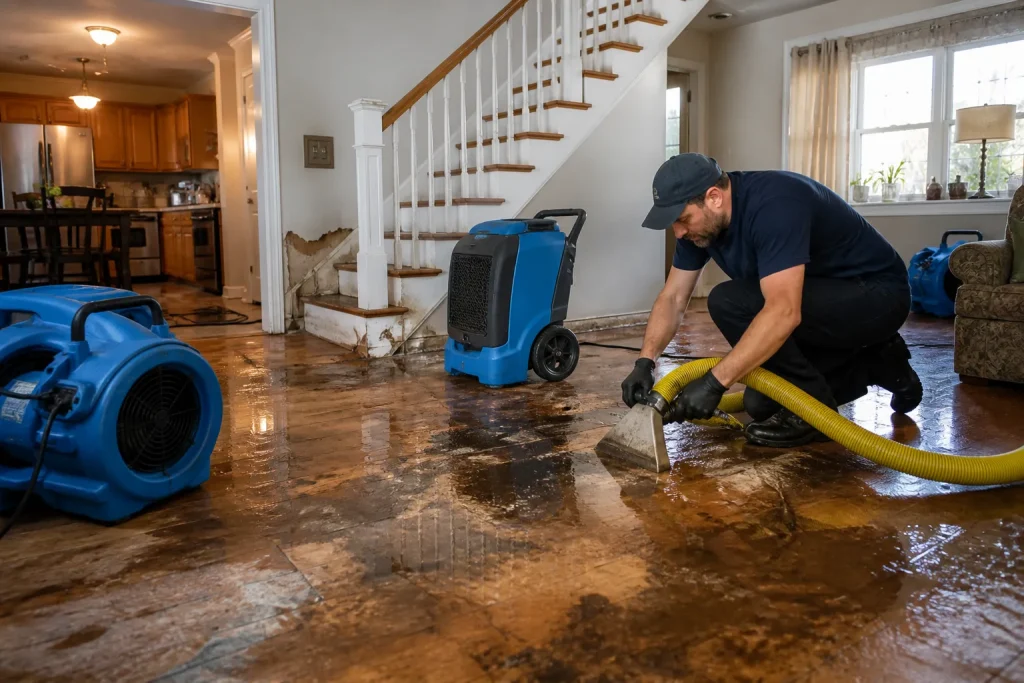
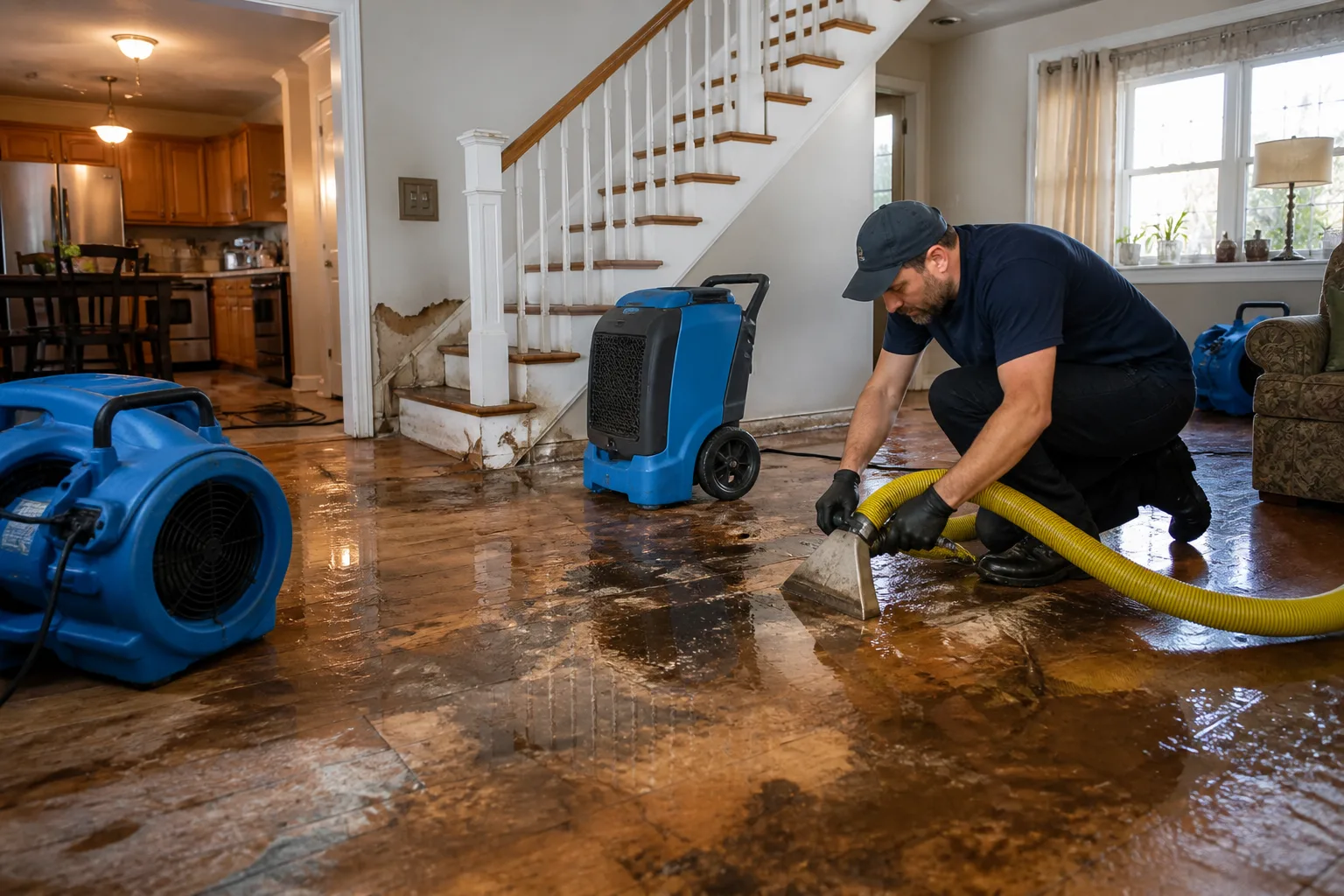
- Drying equipment and daily monitoring: $900-$3,200. You’re paying for commercial dehumidifiers and air movers from brands like Dri-Eaz and Phoenix, plus the labor of daily moisture readings. A 3-to-5-day drying cycle in a finished Astoria basement rarely costs less than $1,200 in equipment and monitoring fees alone.
- Demolition and debris removal: $1,500-$6,000. This covers cutting out wet drywall, pulling saturated carpet and pad, removing baseboards and insulation, and hauling everything out. Pre-1980 Astoria homes with plaster-and-lath walls cost more to demo than modern drywall builds.
- Mold and contamination testing (if triggered): $300-$1,100. Testing isn’t automatic. It’s triggered when water sat for more than 48-72 hours, when sewage is present, or when visible microbial growth appears during demo. If your estimator skips mention of when testing becomes necessary, that’s a red flag.
- Structural rebuild and finish work: $2,000-$15,000+. This is drywall replacement, trim, paint, flooring, and any subfloor or framing repair. It’s the most variable line because it depends entirely on what demolition revealed.
In Astoria specifically, we see two recurring cost factors that generic pricing guides miss. First, many pre-war basements have concrete floors poured directly over soil with no vapor barrier, so after a flood the concrete itself holds moisture and adds drying time. Second, row houses share party walls, and water that passes through a shared wall into the neighbor’s property changes the job scope and often the insurance conversation entirely. We’ll get to that.
Flat-Rate vs. Time-and-Materials: Which Protects You in Astoria
The single biggest pricing decision a homeowner makes isn’t which contractor to hire. It’s which estimate structure to accept. Flat-rate quotes lock the full job into one number. Time-and-materials quotes price labor and equipment by the day or hour, with a not-to-exceed ceiling in the best cases. In a small, fully visible job, flat-rate is cleaner. In a bigger Astoria flood where water has been sitting behind walls for days, time-and-materials with a written cap usually protects you better, because the contractor has no incentive to rush drying or skip moisture readings to protect a thin quote.
Here’s the honest math. A flat-rate quote for a finished basement flood in a Ditmars-area row house last year came in at $6,400. Demo revealed the water had wicked four feet up the party wall into insulation nobody could see from the outside. The job ended at $11,200 with change orders. A time-and-materials quote from a contractor who had already built those change orders into the estimate, with real daily monitoring and a stated dry standard, would have started higher but ended at nearly the same number without the mid-job argument. When a quote looks too clean, it usually means the estimator didn’t look hard enough.
The exception is straightforward jobs. A burst washing machine supply line in a tile-floor utility room with no finished walls is a flat-rate job, and a reputable Astoria contractor should quote it confidently. When there’s drywall, insulation, carpet, or anything structural involved, insist on seeing the daily monitoring plan and ask what happens to the price when hidden moisture extends the drying window. If the answer is a shrug, get another quote. We answer that question in writing before we start, every time.
How Insurance Direct Billing Actually Works in 2026
“We bill the carrier directly” is a phrase every restoration company uses, but it doesn’t all mean the same thing. In practice, direct billing means the contractor submits the estimate, moisture logs, photo documentation, and equipment records to your insurance carrier and waits for approval before invoicing you for anything beyond your deductible. The homeowner’s out-of-pocket exposure should be the deductible and any line items the carrier denies. The problem is which line items get denied, and who’s left holding them.
Carriers routinely push back on three things in Astoria claims. First, they challenge drying time when daily moisture readings aren’t logged properly, so the homeowner gets stuck with 2 extra days of equipment rental. Second, they deny rebuild scope they call “betterment,” meaning if your 20-year-old carpet was wet but not destroyed, they’ll cover replacement at depreciated value, not new. Third, they question demolition photos that don’t clearly show the water line, the affected materials, and the depth of saturation. Contractors who rush demo without photographing every cut do real financial damage to their customers.
Direct billing works best when one company handles the entire job from extraction to rebuild. When the mitigation and reconstruction are split across two contractors, the carrier gets two sets of documents with two sets of dates and two scopes, and the homeowner becomes the messenger correcting both. We’ve rebuilt too many Astoria basements after a mitigation-only company walked away with a drying certificate and left the homeowner holding an estimate that didn’t match the insurance adjuster’s file. One company, one file, one claim. It’s the difference between a check that clears and a three-month fight over line items.
Your deductible is your deductible regardless of who bills. In Astoria, most homeowners carry $1,000 or $2,500 deductibles. High-deductible policies are common, and some carriers now offer separate wind and water deductibles that can push out-of-pocket costs higher. We tell every customer to read the water damage section of their policy before they need it. Not after.
Hidden Cost Triggers a Legitimate Astoria Estimator Flags Upfront
This is where experience matters more than equipment. Astoria’s housing stock is old. Roughly two-thirds of the residential buildings in our service area were built before 1960, and that means the risk profile is different from a newer Queens development. An estimator who knows the neighborhood will flag these items before work starts, not after a change order hits the table.
The first is asbestos. Astoria homes built before 1980 commonly have asbestos in floor tiles, mastic adhesive, pipe insulation, and occasionally in drywall compound. Water damage doesn’t disturb asbestos by itself, but demolition does. If wet flooring or walls need to come out and the materials test positive, abatement adds anywhere from $1,000 to $6,000 depending on square footage, and the work must be done by a licensed abatement contractor. A legitimate estimator mentions this possibility before quoting. A contractor who “discovers” it mid-demolition has just handed you a surprise bill and a three-day delay.
The second is lead paint. Pre-1978 Astoria buildings may have lead paint under newer layers, and cutting into those walls triggers Renovation, Repair and Painting rules that require containment and certified work practices. The added cost is usually modest, $300 to $800, but the testing and documentation take time, and time is the one thing a mid-job change order never gives you back.
The third is the shared sewer line. Row houses in Astoria often share sewer laterals with a neighbor. When a sewage backup is the source of the water damage, the question of whose line failed and who pays for the repair becomes a two-property negotiation. A contractor who works in Astoria row houses regularly has handled this. One who mostly works detached single-family homes in Nassau County hasn’t, and you’ll be the one teaching them.
What a 90-Day Workmanship Guarantee Actually Protects
Most restoration estimates include no line item for a workmanship guarantee, and most homeowners don’t ask about one because they assume every contractor stands behind their work. That assumption costs people real money. Here’s what a serious guarantee means in pricing terms, and here’s why its absence is a financial risk, not a savings.
A workmanship guarantee protects against defects that show up after the job is closed: drywall seams that crack because the framing wasn’t dried to the proper moisture content, flooring that buckles because subfloor moisture was still too high, paint that peels because the surface was sealed before it dried. These failures can take weeks to appear, and by then the insurance claim is closed and the carrier considers the file done. Without a written guarantee, you’re paying out of pocket for a second repair.
We write a 90-Day Done Right Promise into every contract. It’s a specific thing, not marketing language: if the work isn’t done right, we make it right, no paperwork battles and no arguing. It doesn’t add a line item to the estimate because it’s not an upsell. It’s the cost of doing the job properly enough that we can afford to guarantee it. A contractor who won’t put a guarantee in writing is telling you something about their confidence in their own drying process.
When you’re comparing quotes in Astoria, ask the question directly: “What happens if the floor buckles in two months?” Watch the answer. If it’s a verbal promise, subtract that promise from the quote value. A guarantee that isn’t written isn’t a guarantee. Water Damage Restoration in Astoria should always include a written standard for what “dry” means and a written promise for what happens if the work fails.
When to Call a Pro, and When to Grab a Mop
Not every water event needs a restoration crew. A window left open during a rainstorm that wet a few square feet of hardwood and nothing else is a mop-and-fan situation, provided you can get air moving within hours and the water didn’t touch drywall. A roof leak that dripped onto a bathroom floor for a night before you caught it is likely something you can dry with a fan and a dehumidifier, if you’re diligent.
But if water touched drywall, insulation, carpet pad, or anything that can’t be fully dried within 48 hours, call a professional. Water in wall cavities doesn’t evaporate on its own in an Astoria basement, which is below grade and holds humidity even in dry weather. Mold starts colonizing wet building materials in 24 to 48 hours, and the mold you can’t see behind the baseboard is the mold that becomes a $6,000 remediation project later. We pulled one out of a garage over near Astoria Park last month where a homeowner had “dried” a flooded utility wall with box fans for a week. The drywall felt dry to the touch. The stud cavity behind it was at 38% moisture content, and the side of the drywall facing the cavity was already black. The $400 fan job became a $4,700 mitigation. That’s a cheap lesson compared to what happens when someone waits a month.
Related services in Astoria we handle on the same files: Mold Remediation in Astoria when water sat too long, and Fire & Smoke Damage Restoration in Astoria when a water-damage claim follows a fire-suppression event. Both start the same way, with an honest read of moisture data and written scope before work begins.
The Bottom Line
The number on a water damage estimate in Astoria only tells you the size of the problem the estimator could see. The number you actually pay is determined by what the estimator looked for, what the contract structure allowed, and whether the contractor carried a written guarantee. Before you sign anything, get the five phases broken out line by line. Ask whether the quote is flat-rate or time-and-materials. Ask who bills the insurance carrier and what happens when the carrier pushes back. Ask what hidden triggers apply to your specific building, because an Astoria pre-war row house has different answers than a 1990s condo conversion. And ask for the guarantee in writing.
If you’re in Astoria and dealing with water damage right now, call Floodline Restoration Co. at (518) 800-3751. We’ll come out, read the moisture, and give you a written scope and an honest estimate before any work starts. Senior and veteran customers get a 5% discount on every job, always. And every estimate includes the 90-Day Done Right Promise, written in the contract, not in a slogan.
Frequently Asked Questions
Most Astoria water damage restoration jobs cost between $2,200 and $7,800 for a contained single-room event, while finished basement floods with sewage and structural drying typically run $9,000 to $18,000 or more depending on rebuild scope. The real variable is what demolition reveals behind walls and under flooring. Call (518) 800-3751 for a free written estimate from a certified estimator who opens the wall before quoting, not after.
Most standard homeowners policies cover sudden and accidental water damage from burst pipes, appliance failures, and storms, but they exclude gradual leaks, ongoing seepage, and flood damage from rising groundwater. When coverage applies, Floodline Restoration Co. bills your carrier directly, handles the adjuster communication, and documents every phase with photos and daily moisture logs so the claim has the evidence carriers actually accept. Your out-of-pocket exposure should be limited to your deductible.
Floodline Restoration Co. answers the phone with a live dispatcher 24 hours a day, 7 days a week, and we can have a certified crew at your Astoria property the same day you call, including nights and weekends. Extraction equipment typically runs the same visit. The faster water is extracted and drying starts, the less demolition and rebuild the job requires, which is money back in the claim and less time out of your home.
If water touched drywall, insulation, carpet pad, or any enclosed wall cavity, you need professional drying equipment and moisture monitoring, not box fans. Water in an Astoria basement wall cavity won’t fully dry on its own, and mold colonization starts within 24 to 48 hours on wet building materials. A $200 fan setup can become a $5,000 mold remediation project. If the water was clean, visible, and on a hard surface you can dry within 48 hours, DIY may be fine. If you can’t see where the water went, call a professional at (518) 800-3751 and get an honest read before the damage spreads.
Written by Curt Bowman, Owner at Floodline Restoration Co., serving Astoria since 2010.
Need Damage Restoration Help?
Call Floodline Restoration Co. - licensed & insured, here with fast after-hours help in Astoria.
(518) 800-3751